Thursday, December 17, 2009

Workout of the Day:
Pendlay Row
5-5-5-5
(Thanks as always to our friends at Catalyst Athletics for the great instructional videos.)
and then,
For max reps:
3 minutes of Burpee-Pull-Ups
1 minute of Rest
3 minutes of Anchored Sit-Ups
1 minute of Rest
2 minutes of Burpee-Pull-Ups
1 minute of Rest
2 minutes of Anchored Sit-Ups
(Keep track of burpee-pull-up and sit-up numbers separately and record both.)

Tausha of the 9:30 crew warming up for single-leg deadlifts

Tausha of the 9:30 crew warming up for single-leg deadlifts

More On Recovery:  How Much You Sleep – Part Two
Written by Mike Hom

As we began discussing on yesterday’s post, your sleeping position affects your recovery, posture and a host of other factors that affect your overall fitness. We looked at the most common sleep position – the fetal position, but now let’s take a look at some of the other common sleeping positions and their potential affects on your well-being.

On Your Stomach (aka, “Freefaller”)

I can’t explain why, but it seems that more women than men prefer to sleep on their stomachs.  In any case, sleeping on the stomach does some amazing things to help get your body into dysfunction.  Let’s start with the spine.  This may be news to you, but sleeping on your stomach adds this kind of “reverse creep” where your spinal vertebrae experience added pressure as a result of forced extension.  Every time you breathe you add a tiny bit of pressure on your spine that, over time, could contribute to spinal degeneration.  Aside from that, this extension of the spine and some forced contraction of the erectors can cause your abs to relax (think antagonist muscle groups).  Do this long enough and you get a few things happening, including overcompensation of your hip flexors and habitual over-extension of your spine as a result of lazy abs.  Moving up the body to the head, unless you take pleasure in sleeping with your face in the pillow, most people sleep on their stomachs with their head wrenched in one direction.  Now I don’t know about you guys, but having my head forcefully turned to one side for more than 5 minutes leads to some extreme discomfort and gives me headaches.  Without going into details, wrenching your head translates down your neck and into your shoulder girdle and can cause all sorts of muscular and cervical spine dysfunction.

On Your Back (aka, “Soldier”)

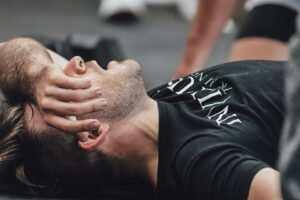
Most health practitioners advocate sleeping on your back.  The reason is that sleeping on your back is most akin to standing in a neutral position.  I used to be a fetal position sleeper myself until I started having odd shoulder pains.  After reading up on sleeping positions, I trained myself to sleep on my back and I started to feel a lot better.  Your back is neutral; your skeletal structure is neutral.  The only real drawback is how your cervical vertebrae is aligned, depending on the type of pillow you sleep on and how many pillows you like to have below your head.  In any case, sleeping on your back is most preferable as your body is mostly aligned correctly.  I get it, though.  Some folks find sleeping on their backs uncomfortable and almost “unnatural” – not to mention the potential discomfort for those who snore (or sleep in the same bed with those who snore).

There are plenty of other sleeping positions that could be discussed, but the takeaway here is that putting your body in an odd posture is not conducive to good sleeping and can affect your training.  If you can sleep on your back, do it more often.  If you can’t, try harder to sleep on your back, or at the very least, to sleep on your back as much as possible.  I can’t guarantee you will have a better night’s sleep, but if you can get used to it, it will definitely help.

Happy snoring!

Tags:

7 Responses to “Thursday, December 17, 2009”

  1. AT says:

    POS – Nice – Those pics never surfaced :)

  2. POS says:

    AT- Yet……..

  3. Areba says:

    Over the last year my body has been forcing me to start trying to sleep on my back. I used to be a stomach sleeper, yes, with my head wrenched to one side. Once I had a baby, however, I found myself sleeping on my side with one arm folded up under my pillow. This was so I could breast feed and sleep at the same time. After doing this for over a year it had then become a habit. About a year ago or so I started waking up to numb fingers and arm. What did I do? Flipped over. Result? Numb arm and fingers. I have blamed the bed. It is too hard I kept saying. So we bought the memory foam mattress topper. Still not enough. Bought a pillow top mattress pad to go over the memory foam. Really?? Still??? OK, the only solution, TO SLEEP ON MY BACK! It is still not an easy task but 8 out of 10 times I will sleep through the night versus tossing and turning and having to shake the blood back into my limbs in the middle of the night… Thank you for this post! Now at least I know why my body is rejecting my sleep position and have saved my husband from the expense of a new bed!! Two weeks ago I even bought myself the posture pedic memory foam neck pillow… ahhhh, sleep at last!! :)

  4. Big Ben says:

    I sleep in an OHS position…

  5. Mark Riebel says:

    Keep in mind though, that for many people sleeping on one’s back will still have the effect of some over-extension. This is because of the slight anterior pelvic tilt a lot of folks end up with in this position. But that is easily remedied by putting a pillow under your things or knees which puts the spine in a much more neutral position.

  6. Bill says:

    I couldn’t sleep on my back for years due to apnea. I finally got the treatment I need, and now that’s the only way I sleep. Being able to breath is easily taken for granted!